Verified Solar UK Logo
Independent UK Renewable Registry • 100% MCS Certified

Verified UK Solar & Battery Storage Installers

Find vetted, local solar contractors across England, Scotland & Wales. Direct engineer phone lines, guaranteed 0% VAT compliance, and zero brokered sales calls.

2,041
Vetted Installers
64
UK Counties
100%
MCS Validated
£0
0% VAT Relief
✓Consumer Protection Notice: All listed renewable contractors undergo daily verification against the official Microgeneration Certification Scheme (MCS) registry. Direct pricing is fixed under standard consumer protection contracts with zero broker markups.
Q2 2026 Audit Log ActiveDNO G98 / G99 Compliant
The Verified Solar Directory Charter

Built for Radical Consumer Transparency & Rigorous Standards

We reject aggressive lead-capture funnels and unvetted subcontractors. Every installer listed on VerifiedSolar.uk must satisfy our three non-negotiable consumer pillars.

✓

100% MCS Validated

Certification under the Microgeneration Certification Scheme is legally mandatory to qualify for the UK Government's 0% VAT relief and Smart Export Guarantee (SEG) payments.

🛡️

Zero Cold-Call Guarantee

Your personal contact details are never brokered to aggressive boiler-room call centers. You contact certified engineers directly on their transparent business phone lines.

⚙️

Direct Warranties

All equipment installations are covered by tier-1 direct manufacturer warranties: minimum 25-year photovoltaic linear performance and 10 to 15-year battery cycling guarantees.

National Coverage

Browse Solar Installers by UK County

Select your region to view local certified contractors, average installation costs, and regional solar irradiance data.

West Midlands

6 Cities & Towns
111 Installers→

Greater Manchester

5 Cities & Towns
86 Installers→

Essex

3 Cities & Towns
85 Installers→

West Yorkshire

4 Cities & Towns
77 Installers→

Devon

3 Cities & Towns
74 Installers→

Hampshire

3 Cities & Towns
68 Installers→

Lincolnshire

3 Cities & Towns
62 Installers→

North Yorkshire

3 Cities & Towns
60 Installers→

South Yorkshire

3 Cities & Towns
58 Installers→

Tyne and Wear

4 Cities & Towns
58 Installers→

Berkshire

2 Cities & Towns
56 Installers→

Greater London

2 Cities & Towns
55 Installers→

Derbyshire

2 Cities & Towns
54 Installers→

County Antrim

3 Cities & Towns
48 Installers→

Gloucestershire

2 Cities & Towns
45 Installers→

Dorset

2 Cities & Towns
44 Installers→

Cambridgeshire

2 Cities & Towns
43 Installers→

Lancashire

3 Cities & Towns
41 Installers→

Nottinghamshire

2 Cities & Towns
39 Installers→

Norfolk

1 City
36 Installers→

Leicestershire

1 City
35 Installers→

Suffolk

1 City
35 Installers→

Hertfordshire

2 Cities & Towns
34 Installers→

East Riding of Yorkshire

1 City
34 Installers→

City of Glasgow

1 City
34 Installers→

City of Bristol

1 City
33 Installers→

East Sussex

1 City
31 Installers→

Staffordshire

1 City
31 Installers→

Northamptonshire

1 City
31 Installers→

Merseyside

1 City
31 Installers→

Cheshire

2 Cities & Towns
31 Installers→

Buckinghamshire

1 City
29 Installers→

Kent

2 Cities & Towns
28 Installers→

West Glamorgan

1 City
27 Installers→

Wrexham

1 City
25 Installers→

Surrey

1 City
24 Installers→

County Durham

3 Cities & Towns
23 Installers→

Gwent

1 City
23 Installers→

West Sussex

1 City
21 Installers→

Herefordshire

1 City
19 Installers→

City of Edinburgh

1 City
18 Installers→

Shropshire

2 Cities & Towns
17 Installers→

Worcestershire

1 City
17 Installers→

Renfrewshire

1 City
17 Installers→

Wiltshire

1 City
16 Installers→

Dundee City

1 City
16 Installers→

Somerset

1 City
15 Installers→

City of Aberdeen

1 City
15 Installers→

South Glamorgan

1 City
15 Installers→

Oxfordshire

1 City
14 Installers→

Cornwall

1 City
13 Installers→

Perth and Kinross

1 City
13 Installers→

South Ayrshire

1 City
13 Installers→

South Lanarkshire

1 City
11 Installers→

County Down

2 Cities & Towns
10 Installers→

Gwynedd

1 City
7 Installers→

Stirling

1 City
6 Installers→

Dumfries and Galloway

1 City
6 Installers→

Bedfordshire

2 Cities & Towns
5 Installers→

Cumbria

1 City
5 Installers→

County Londonderry

1 City
5 Installers→

Highland

1 City
3 Installers→

Ceredigion

1 City
3 Installers→

County Armagh

1 City
2 Installers→
⚡ UK Energy Yield Estimator

Independent UK Solar & Battery Savings Calculator

Adjust your monthly electricity bill and home size to see real-time estimated savings, system sizing, and payback years in the UK.

£140 / mo
£60/mo£200/mo£400+/mo
Estimated System Specification4.3 kWp Array (10 Panels) + 9.5kWh Battery
Estimated Annual Savings
£1,110 / yr
Bill reduction + SEG feed-in payments
Estimated Payback Period
6.7 Years
Includes 0% VAT UK incentive
Est. Generation
3,950 kWh
CO2 Offset
830 kg / yr
25-Yr Net Benefit
£20,350+
Find local MCS installers in your area:View Local Installers→
Residential Battery Systems

Maximise Self-Consumption with Tier-1 Battery Storage

Without a home battery, UK households typically export 60% of their daytime solar electricity for modest feed-in tariffs. Pairing your solar array with a certified home battery increases your self-consumption to over 75%, insulating your home against peak grid electricity prices.

Tesla Powerwall 3: 13.5 kWh capacity with integrated solar inverter.
GivEnergy All-In-One: British engineered 9.5kWh & 13.5kWh modular storage.
SolarEdge Home Battery: High-efficiency DC-coupled storage with panel-level optimization.
UK Residential Battery Benchmarks0% VAT Eligible
Tesla Powerwall 3
13.5 kWh Usable • 11.5 kW Continuous Backup
£8,500 - £9,800
GivEnergy All-In-One
13.5 kWh Usable • British Engineering
£7,200 - £8,600
SolarEdge Home Battery
9.7 kWh Usable • 94.5% Round-Trip Efficiency
£6,500 - £7,800
Estimated costs include certified MCS electrical installation under 0% VAT relief.
Official PVGIS Irradiance Model

Solar Radiation & Generation Yield in United Kingdom (National Benchmark)

Ground-truth solar irradiance data for United Kingdom (National Benchmark) based on the European Commission PVGIS-SARAH2 satellite database and UK Met Office climate records.

Annual 4kWp Yield
3840 kWh
Specific Yield
960 kWh/kWp
Optimal Roof Tilt
36° facing South (180°)
Maximises annual generation
Daily Solar Irradiance
3 HSP / day
Annual average peak sun hours
Seasonal Production Split
75% Apr-Sep
High yield spring-summer window
Primary DNO Grid
UK Power Networks (UKPN)
Fast-track G98 compliant
MonthDaily Irradiance (HSP)Estimated 4kWp Output% of Annual Total
JanuaryLow1.06 kWh/m²/day109 kWh2.8%
February1.72 kWh/m²/day160 kWh4.2%
March2.92 kWh/m²/day301 kWh7.8%
April4.22 kWh/m²/day421 kWh11%
MayPeak5.02 kWh/m²/day517 kWh13.5%
JunePeak5.36 kWh/m²/day535 kWh13.9%
JulyPeak5.22 kWh/m²/day538 kWh14%
AugustPeak4.56 kWh/m²/day470 kWh12.2%
September3.46 kWh/m²/day345 kWh9%
October2.16 kWh/m²/day223 kWh5.8%
NovemberLow1.32 kWh/m²/day132 kWh3.4%
DecemberLow0.86 kWh/m²/day89 kWh2.3%
Total Annual Yield3.00 HSP avg3840 kWh100.0%
Why winter generation matters: Even in December and January when solar irradiance dips to ~0.70 - 1.15 HSP, a properly commissioned MCS system continues generating electricity from diffuse daylight. Pairing your array with a 9.5kWh home storage battery allows you to charge overnight at ultra-low off-peak rates (e.g. 7p/kWh on Octopus Intelligent) to cover daytime shortfalls.
Source Methodology: European Commission Joint Research Centre (PVGIS-SARAH2) + UK Met Office Climate Data. Standard 14% system loss (wiring, inverter efficiency, thermal coefficient -0.35%/°C).DNO Regulatory Standard: ENA Engineering Recommendation G98/G99
Editorial Analysis • United Kingdom

UK Solar Panel Guide: Economics, Technology & Accredited Installation

The United Kingdom's domestic solar microgeneration sector has experienced unprecedented technological and economic maturity. Driven by high retail electricity costs under the Ofgem domestic price cap (~26p/kWh) and significant improvements in photovoltaic cell efficiency, over 1.4 million British homeowners have now installed rooftop solar panels. A standard 4kWp domestic system generates between 3,100 kWh and 4,100 kWh of clean electricity annually across Great Britain, covering up to 70% of an average household's annual power requirements.

To support the transition towards national Net Zero targets, HM Treasury has extended the 0% VAT relief policy on residential energy-saving materials through March 2027. This exemption removes the full 20% Value Added Tax on solar panels, home battery storage, and heat pumps, saving homeowners between £1,000 and £1,600 on turnkey installations. Simultaneously, the Smart Export Guarantee (SEG) mandates that licensed electricity suppliers pay homeowners for every kilowatt-hour of surplus clean electricity exported back to the grid.

Verified Solar UK was established as an independent consumer protection registry to eliminate the confusion and aggressive sales tactics prevalent in the renewable energy market. We index and independently verify 2,041 MCS accredited solar and battery storage contractors across 64 UK counties and 109 cities, providing direct engineer phone lines, transparent pricing benchmarks, and zero cold-calling.

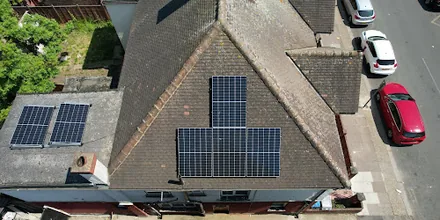
0% VAT & UK Clean Energy Grants

UK Solar Incentives: 0% VAT, SEG Tariffs & Government Grants

Understand the legal and financial mechanisms supporting residential solar panel adoption across England, Scotland, and Wales:

1

Statutory 0% VAT Relief on Panels and Batteries

Residential installations enjoy complete exemption from Value Added Tax under UK Treasury rules, saving £1,000 to £1,600 on average domestic turnkey quotes.

2

Smart Export Guarantee (SEG) Tariffs (12p - 15p/kWh)

Suppliers such as Octopus Energy, E.ON Next, and OVO pay guaranteed export rates for clean power exported back to the National Grid, generating £150 to £280 annually.

3

UK Government ECO4 Grant Scheme

Under the Energy Company Obligation (ECO4), low-income households claiming qualifying benefits with EPC ratings of D-G can receive 100% grant-funded solar panels and heat pumps.

4

Great British Insulation Scheme (GBIS)

Complements rooftop microgeneration by providing subsidised cavity wall and loft insulation to reduce household thermal leakage before solar commissioning.

These statutory policies reduce the net barrier to entry, ensuring domestic solar microgeneration remains one of the safest tax-free investments for UK households.

Quality Assurance Charter

How to Choose an Accredited UK Solar Installer: 4 Key Vetting Rules

Protect your home and investment by verifying that your solar contractor satisfies four non-negotiable industry standards:

✓

MCS Accreditation (Microgeneration Certification Scheme)

The fundamental benchmark for UK renewable installations. MCS certification is legally required to claim the UK Government 0% VAT relief and register for the Smart Export Guarantee (SEG) with energy suppliers.

✓

Consumer Code Membership (RECC or HIES)

Guarantees that your deposit is insured through an independent financial protection scheme, terms are transparent, and you have access to an approved alternative dispute resolution service.

✓

Part P Electrical Safety & Competent Persons Scheme

All electrical connections from inverter to the consumer unit must be signed off by a NICEIC, NAPIT, or ELECSA registered electrician, issuing a formal Building Regulations Compliance Certificate.

✓

ENA G98 / G99 Grid Notification & DNO Approval

Systems with inverters up to 3.68kW per phase must be notified under ENA G98 within 28 days of commissioning. Larger systems require prior G99 network permission from the regional Distribution Network Operator.

Array Sizing Matrix

Solar Panel Sizing & Battery Storage Configurations for UK Homes

Explore standard residential photovoltaic sizing configurations tailored to property profiles across Great Britain:

🏠

Small Terraced Home (1-2 Bed)

3.0 kWp Array (8 Panels)

Compact residential setup generating ~2,600 - 3,100 kWh/year. Reduces electricity bills by £600-£750 annually with minimal roof footprint.

🏡

Semi-Detached (3-4 Bed)

4.2 kWp Array (10-11 Panels)

The UK benchmark system. Generates ~3,500 - 4,200 kWh/year, cutting electricity bills by £950-£1,200/year and matching typical family daytime demand.

⚡

Detached Home with Battery

6.0 kWp + 9.5kWh Battery

High-capacity array producing ~5,000 - 6,200 kWh/year. Delivers up to 80% grid independence and supports smart off-peak EV charging.

🔋

All-Electric / Heat Pump Home

8.0 kWp + 13.5kWh Storage

Comprehensive microgeneration system yielding ~6,800 - 8,200 kWh/year. Powers heat pumps and heavy domestic loads with whole-home backup.

Transparent Market Benchmarks

UK Solar Panel & Battery Storage Price Guide (2026 Turnkey Market)

Current average turnkey pricing benchmarks for domestic solar and battery storage systems across the United Kingdom:

Property TypeSystem SizePanel ConfigurationTurnkey Cost (0% VAT)Est. Annual SavingsEst. Payback
Terraced House (1-2 Bed)3.0 kWp (8x 400W Panels)8 Panels£4,800 - £5,800£650 - £800 / yr6.8 Years
Semi-Detached (3 Bed)4.0 kWp (10x 400W Panels)10 Panels£5,600 - £6,800£900 - £1,150 / yr6.2 Years
Semi-Detached + Battery4.0 kWp + 5.2kWh Battery10 Panels + Storage£8,500 - £10,200£1,250 - £1,500 / yr6.9 Years
Detached Home (4+ Bed)6.0 kWp + 9.5kWh Battery15 Panels + Storage£11,200 - £13,500£1,650 - £2,100 / yr6.5 Years

UK Planning Permission & DNO Grid Approval (G98 / G99)

Across England and Wales, domestic rooftop solar installations are classified as Permitted Development (Class A, Part 14) under the General Permitted Development Order. In the vast majority of cases, homeowners do not need to apply for planning permission, provided the solar panels project less than 200mm from the roof slope, are positioned below the highest ridge line, and are removed when no longer operational.

Specific planning consent is only required if your property is a statutory Listed Building, sits within a World Heritage site, or is subject to an Article 4 Direction in a Conservation Area. In addition, all grid-tied microgeneration systems must comply with Energy Networks Association standards: systems up to 3.68kW per phase require ENA G98 notification within 28 days of commissioning, while larger arrays require prior ENA G99 approval from your regional Distribution Network Operator.

Frequently Asked Questions

Frequently Asked Questions About UK Solar Panels

How much do solar panels cost in the UK in 2026?▼

A typical 4kWp domestic solar panel system (10 Tier-1 panels) costs between £5,500 and £6,800 under the current UK 0% VAT relief scheme. Adding a 9.5kWh home battery typically brings the total turnkey cost to £9,500 to £12,200, including scaffolding, inverter, and electrical certification.

Do solar panels work effectively in cloudy British weather?▼

Yes. Modern photovoltaic cells utilise both direct sunlight and diffuse daylight. While generation peaks on clear sunny days, high-efficiency monocrystalline panels (N-Type TOPCon and HJT) continue producing electricity on overcast and rainy days across the UK.

What is the Smart Export Guarantee (SEG) and which suppliers pay the most?▼

The Smart Export Guarantee is a government mandate requiring energy suppliers with over 150,000 customers to pay homeowners for exported renewable electricity. Leading suppliers like Octopus Energy (Intelligent Outgoing / Outgoing Fixed) currently offer market-leading export rates between 12p and 15p per kWh.

What is the MCS certificate and why is it legally required?▼

The Microgeneration Certification Scheme (MCS) certifies the quality, safety, and performance of renewable energy installations in the UK. Having an MCS certificate is mandatory to claim the 0% VAT relief and register for the Smart Export Guarantee with energy suppliers.

What is the average payback period for UK residential solar?▼

For a standard 4kWp system, the average payback period across the UK is currently 6.0 to 7.5 years. With panel manufacturers offering 25-year performance warranties, homeowners benefit from approximately 18 to 19 years of completely free, clean electricity after recouping their initial investment.